HEAT & PolyBlend 35
PolyBlend 35 Removes Heat Natively
PolyBlend 35 helps dissipate heat more effectively than oil alone, which can help maintain stable engine operating temperatures under load. ASTM testing revealed a temperature drop from 317F to 167F when mixed with PolyBlend 35.

WEAR & PolyBlend 35
PolyBlend 35 Provides 40% Better Anti-Wear
Independent laboratory testing using ASTM standards showed superior wear protection compared to leading base oils. Even using inexpensive petroleum oil in combination with PolyBlend 35, revealed significant anti-wear performance.


Enhanced Oil Life
Many synthetics are pushing for the 10,000 mile oil change
By reducing friction and heat, PolyBlend 35 can help oil maintain its protective properties longer than standard oil alone (actual change intervals vary by application).
The oil filter question
PolyBlend 35 suggests the oil filter changed at 5,000 miles for optimum protection, should oil change intervals be extended.
PolyBlend 35 Testing & Validation Section
Unmatched Anti-Wear

Independent third-party laboratory testing showed up to a 40% reduction in measured wear when PolyBlend 35 was evaluated against benchmark oil formulations under standardized test conditions.
Improved Fuel Efficiency
Real-world observations in over-the-road trucking and gasoline-powered vehicles showed fuel-use improvements ranging from approximately 3% to 13% under specific operating conditions.
Lower Operating Temps
Extended & Enhanced Oil Performance
Laboratory testing observed lower oil operating temperatures when PolyBlend 35 was incorporated into the oil blend under controlled conditions. In applications equipped with auxiliary oil cooling systems, temperature reductions were more pronounced.
PolyBlend 35 may be considered for use in turbocharged engines, where oil temperature management is especially important.
Extended & Enhanced Oil Performance
Extended & Enhanced Oil Performance
PolyBlend 35 is designed to support the performance characteristics of conventional petroleum and synthetic motor oils. When incorporated into the oil blend, laboratory and field observations indicate improved resistance to wear and thermal stress, while preserving the primary functional properties of the base oil under tested conditions.
Start-up Wear
Independent industry reports commonly note that a significant portion of engine wear occurs during start-up. PolyBlend 35 is designed to remain on critical engine components after shut-down, helping provide protection when the engine is started again. This effect can be observed—and even heard—in the before-and-after demonstration videos featured elsewhere on this site.
Bid Farewell To Lifter Tick
Certain engines are prone to lifter noise during start-up. PolyBlend 35 is commonly used to help reduce or eliminate this condition when added during an oil change. For higher-mileage engines, we recommend using an engine cleaning agent beforehand to help ensure optimal results.
Designed with Environmental Responsibility in Mind
Formulation and Packaging with Reduced Environmental Impact
Formulation and Packaging with Reduced Environmental Impact
Formulation and Packaging with Reduced Environmental Impact
PolyBlend 35 is formulated with consideration for both performance and environmental responsibility.
- The formulation is reported to be 95% biodegradable within 30 days based on standard laboratory testing methods
- Flexible packaging is estimated to reduce plastic usage by approximately 80% compared to conventional rigid oil containers
- Product labeling does not list carcinogens or require extensive hazard warnings under applicable Safety Data Sheet classifications
- The Safety Data Sheet does not specify special handling warnings or precautionary statements beyond standard industrial use guidance
- Intended to support performance objectives while allowing consumers to consider environmental impact
Legal / Insurer Footnote Qualifier
Statements are based on internal data, third-party testing where applicable, and Safety Data Sheet classifications current at the time of publication. Results, classifications, and regulatory interpretations may vary by jurisdiction, application, and operating conditions.
Supporting Oil Performance Over Extended Use
Formulation and Packaging with Reduced Environmental Impact
Formulation and Packaging with Reduced Environmental Impact
PolyBlend 35 delivers a level of performance that stands apart in the industry. In demanding real-world applications, including over-the-road trucking, the oil blend is regularly monitored through routine testing for breakdown and degradation. Results show that PolyBlend 35 helps sustain the strength and protective qualities of the oil over extended service periods.
For optimal maintenance and ease of service, we recommend the use of accessible remote oil filter systems. Oil filters can be serviced at intervals appropriate to your application, with oil condition verified through testing. Oil replacement should always be based on test results and manufacturer-recommended maintenance practices.
Evidence You Can Evaluate
Formulation and Packaging with Reduced Environmental Impact
Evidence You Can Evaluate
We recognize that our claims may sound impressive—and we encourage you to verify them for yourself. Independent motor oil testing is widely available online. Choose a testing service, submit an oil sample, and review the results firsthand.
Oil analysis typically costs between $20–$40 and provides insight into oil condition as well as potential engine-related issues. We believe real data is the most powerful proof.
Unplanned Field Observations
Meet Daniel H. / Orlando Florida
Meet Daniel H. / Orlando Florida
Meet Daniel H. / Orlando Florida

Daniel drives a 2018 Ram 1500 4x4 with approximately 120,000 miles. While returning home, he noticed what he believed to be a minor coolant issue. The dashboard coolant temperature indicated approximately 170°F, which initially appeared normal. It was later determined that this reading was inaccurate due to the coolant temperature sending unit being exposed to air.
During the drive, the oil temperature reading remained steady at approximately 220°F. Based on the information available to him at the time, Daniel continued driving and traveled approximately 45 miles to his home at highway speeds of 75–80 mph. Ambient air temperature was approximately 74°F, with typical Florida humidity.
Evaluate the Evidence
Meet Daniel H. / Orlando Florida
Meet Daniel H. / Orlando Florida
After arriving home, Daniel allowed the engine to cool before draining the radiator. Only about one pint of coolant was recovered, despite the system’s normal capacity being approximately 16 quarts (see photo above). The amount of coolant remaining within the engine was unknown. The vehicle was able to continue operating throughout the drive, with oil temperature remaining stable during the event.
His truck stopped burning oil...
Kevin J. / Atlanta Georgia

Customer Testimonial
- I've used Royal Purple synthetic oil for more than 20 years in both my vehicles and race bikes because I've always been impressed with how clean and well-protected my engines look when they're disassembled. My 2017 GMC truck now has over 209,000 miles. Like every truck I've owned, it began consuming oil around the 90,000-mile mark. Typically, I had to add one to two quarts between oil changes, and the tailgate was always coated with dark exhaust residue from the oil being burned. At approximately 189,000 miles, instead of adding another quart of engine oil, I replaced that quart with PolyBlend 35 in my 6-quart oil capacity.
- The results surprised me.
- Since adding PB35, my truck has stopped consuming oil, and I have not needed to top it off. That alone impressed me more than anything else I've tried over the years. I also decided to try the first spin-off of PB35, called Torque Off. I have an old pair of heavily rusted crimping pliers that had become extremely stiff and difficult to use. I rubbed a small amount on the pivot with my finger and let it sit. Afterward, the rust loosened, the joint freed up, and the pliers now operate as smoothly as if they were new. Based on my experience, PB35 and Torque Off have exceeded my expectations both inside my engine and on rusted metal tools.
Individual customer experiences may vary depending on engine condition, maintenance history, and operating environment.
A couple of RAM 1500 stories...
Ernest H. / Atlanta Georgia
Ernest H. / Atlanta Georgia
Ernest H. / Atlanta Georgia
Customer Testimonial
- I was one of the early users of PB35, primarily because I wanted to see if it could help eliminate the well-known HEMI "lifter tick" found in some model years. My truck is a 2017 Ram 1500 equipped with the 5.7L HEMI. The results were immediate. As soon as I added PB35, the lifter tick disappeared—and it has never returned. More than three years later, my engine is still running quietly.
- I also noticed an improvement in fuel economy. To be fair, I "enjoy" the motor, so I haven't consistently tracked every tank. I use a Pedal Commander set to Sport mode, which keeps the engine operating on all eight cylinders rather than allowing the Multi-Displacement System (MDS) to switch to four-cylinder operation. On a recent trip from the northern suburbs of Atlanta to Charleston, South Carolina, I set the cruise control at 77 MPH for nearly the entire drive. Using Shell regular gasoline and maintaining 41 PSI tire pressure, the truck averaged 19.9 MPG! On the return trip, using BP regular gasoline and encountering heavier traffic that required several hard accelerations to approximately 85 MPH, the truck still averaged 18.9 MPG.
- I couldn't be happier with the performance of PB35. Eliminating the HEMI tick alone made the product worthwhile, and the added fuel economy has been an unexpected bonus. After more than three years of use, I continue to be impressed with the results.
- P.S. One additional benefit I've experienced is significantly longer oil service intervals. Rather than changing my oil on a fixed mileage schedule, I periodically send oil samples to an independent laboratory for analysis. I only change the oil when the test results indicate it has reached the end of its useful life. By avoiding unnecessary oil changes, the savings have offset the cost of PB35. For me, that has made PB35 an even better long-term value.
Individual customer experiences may vary depending on engine condition, maintenance history, and operating environment.
Edgar R. / Canton Georgia
Ernest H. / Atlanta Georgia
Ernest H. / Atlanta Georgia
Customer Testimonial
- Like many owners of 5.7L HEMI-powered Ram trucks, I eventually experienced the infamous "HEMI tick." Last year, I had to replace the camshaft and lifters after the factory lubrication design led to excessive wear on the camshaft lobes and lifter rollers. Even after the repair, the engine still developed the familiar tick, and it continued to consume about one quart of oil every 1,200 miles.
- At my next oil change, I decided to try PB35. The difference was noticeable almost immediately. The engine became noticeably smoother and quieter, with stronger acceleration and what appeared to be a small improvement in fuel economy. At first, there was still a very slight tick during startup, but it was dramatically reduced. After driving with PB35, the startup tick disappeared completely.
- Oil consumption also improved significantly. I no longer noticed any measurable oil loss until it was nearly time for my next scheduled oil change, which was a major improvement over adding a quart every 1,200 miles. What impressed me most was the confidence that PB35 wasn't just making the engine quieter—it seemed to leave a protective lubricating film that reduced metal-to-metal contact, especially during cold starts.
- I was so impressed with the engine results that I asked if the technology could also help with seized bolts. My truck came from Canada, so rust is a constant battle underneath. While replacing my front bumper, several factory bolts were nearly impossible to remove, even with a breaker bar. A sample of his new penetrating lubricant formulation (www.TorqueOff.com) was supplied. I worked a small amount into the threads with my finger, waited about ten minutes, and the bolts came loose with surprising ease.
- Overall, I'm extremely pleased with the results. PB35 made my truck quieter, smoother, more responsive, and significantly reduced both the HEMI tick and oil consumption. Based on my experience, I plan to continue using it.
Individual customer experiences may vary depending on engine condition, maintenance history, and operating environment.
Independent ASTM Laboratory Testing — Because Facts Matter

ASTM Testing Overview
ASTM International develops and publishes voluntary, consensus-based international testing standards. ASTM test methods are widely used within the tribology industry to evaluate friction, wear, and extreme-pressure performance of lubricants under controlled laboratory conditions.
The following ASTM tests were conducted to evaluate the performance characteristics of PolyBlend 35 when used in combination with conventional and synthetic motor oils. These tests are designed to model specific wear and load conditions that can occur within internal combustion engines.
Laboratory test results provide comparative data under controlled conditions and are not intended to predict real-world engine life or performance.
ASTM D4172 – Four-Ball Wear Test
The ASTM D4172 Four-Ball Wear Test evaluates wear protection and frictional behavior under boundary lubrication conditions.
- PolyBlend 35 demonstrated an average wear scar diameter of 0.37 mm
- Observed oil temperature during testing was approximately 167°F
- Comparative industry benchmark results commonly report wear scars of approximately 0.40 mm, with higher observed oil temperatures over 317°F.
When the same test was performed using 20 year old aged petroleum oil as the base oil, PolyBlend 35 again produced a wear scar of 0.38 mm, with oil temperature remaining consistent. These results indicate that PolyBlend 35 contributed to reduced wear measurements and lower operating temperatures under the test conditions.
ASTM D2714 – Block-on-Ring Wear Test
The ASTM D2714 Block-on-Ring Test measures sliding wear under controlled load and speed.
- PolyBlend 35 produced an average wear scar measurement of 1.2 mm
- Observed oil temperature during testing was approximately 110°F
These results fall within ranges typically associated with high-performing lubricants under this test method.
ASTM D3233 – FALEX Extreme Pressure Pin & Vee-Block Test
The ASTM D3233 FALEX Extreme Pressure Test evaluates a lubricant’s ability to withstand increasing load before failure.
- At a 35% treatment ratio, PolyBlend 35 demonstrated significantly higher load-carrying capacity compared to untreated petroleum oils
- Performance also exceeded typical results reported for many synthetic oils under similar test conditions
These results indicate enhanced extreme-pressure characteristics when PolyBlend 35 is incorporated into the oil blend.
ASTM Testing Disclaimer
ASTM test results are generated under controlled laboratory conditions and are intended for comparative evaluation only. Actual engine performance, wear rates, and operating temperatures may vary based on engine design, operating conditions, maintenance practices, and oil formulation.

Torque Off Penetrating Oil www.torqueoff.com
Sick of broken bolts, or having to use a 3' cheater bar in a 1' space?
Our team of experts have developed the best penetrating oil you will ever use. Torque Off uses the physics of rust to defeat it. Depending upon the level of corrosion, 2-4 drops + 30-90 minutes, and your project doesn't have to stop overnight!
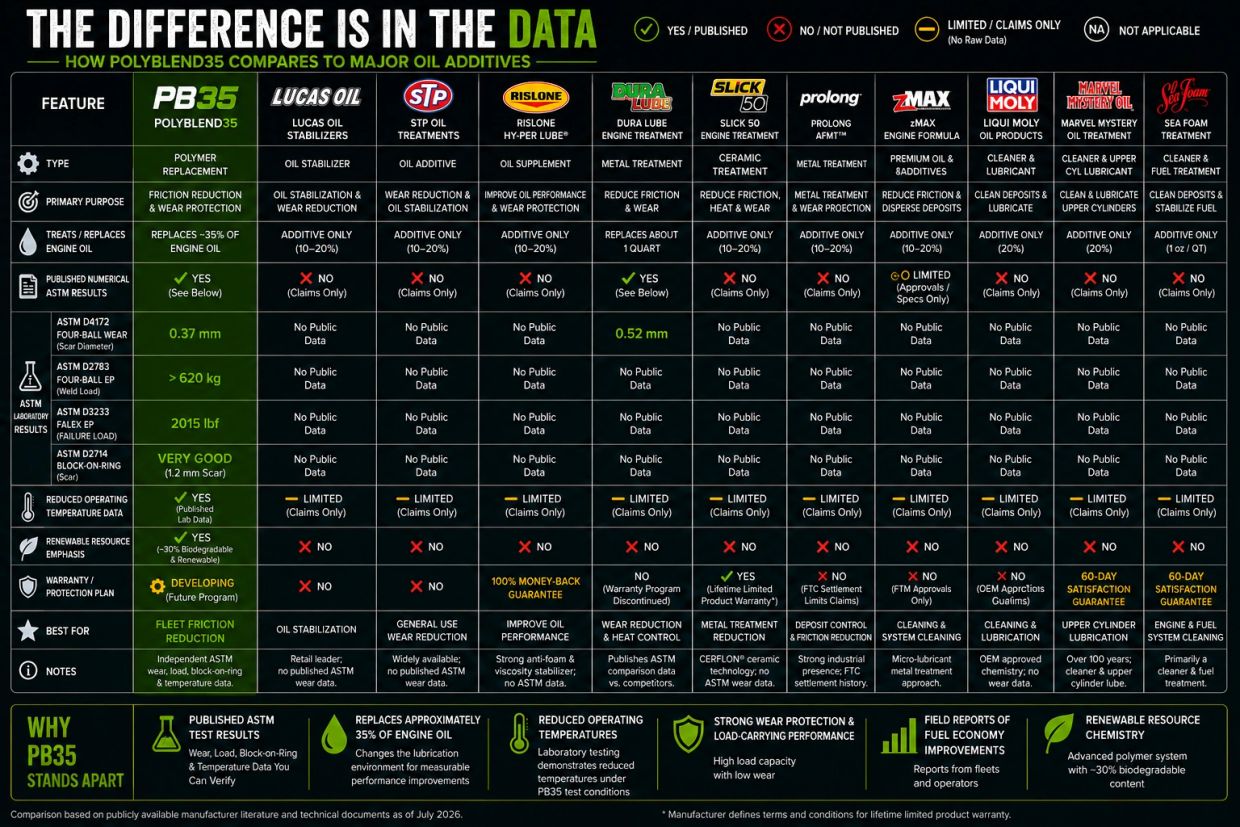
Comparisons
Oil additive charts were constructed from publicly available data.
Which additive have you been using? The PB35 data is extremely compelling.
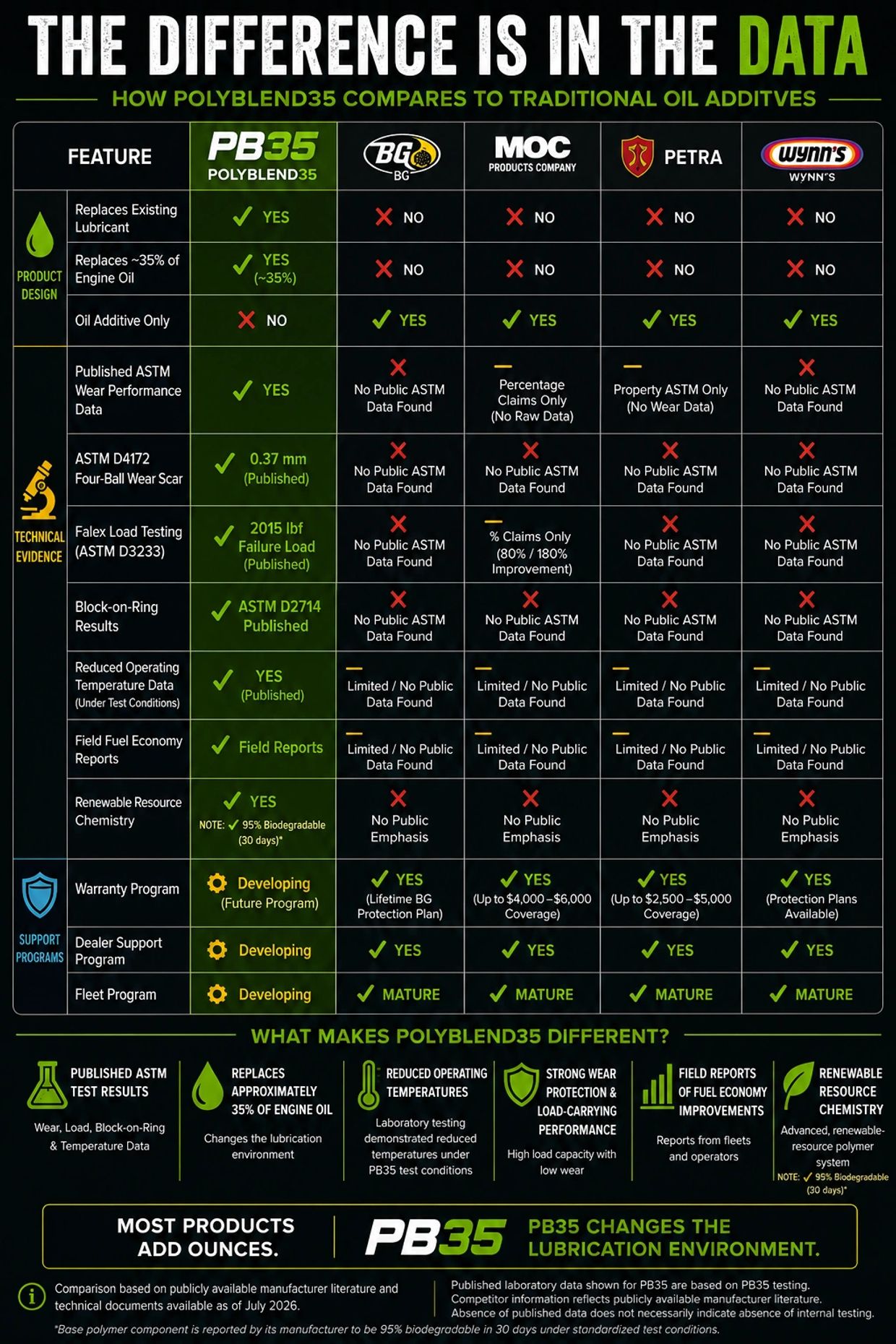
Comparisons of commonly used Fleet Oil Additives
Oil additive charts were constructed from publicly available data.
Which additive have you been using? The PB35 data is extremely compelling.
COMMING SOON!
Specialty blends for manual gearboxes and differentials
At Polyblend 35, our team of experts are developing products for manual gearboxes and differentials.
